




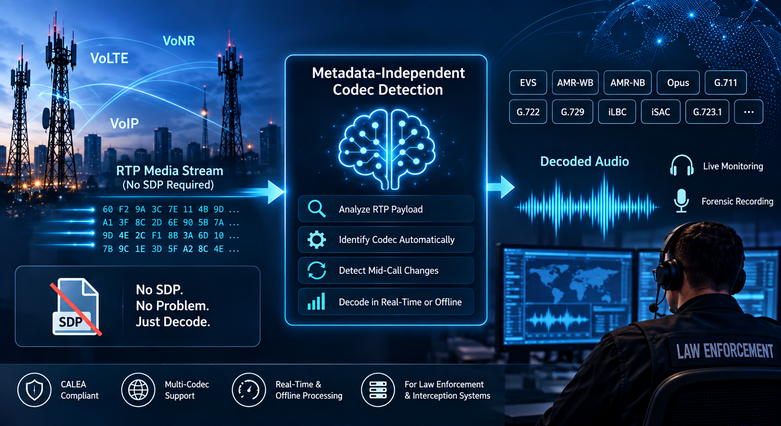
Lawful interception of voice communications has become significantly more complex in the era of VoIP, VoLTE, and VoNR. Unlike traditional circuit-switched telephony, where intercepted audio was uniformly encoded in G.711 over dedicated TDM channels, modern IP-based voice traffic can use any of dozens of codecs, switch codecs mid-call, and traverse multiple network elements that may alter the media stream along the way.
For law enforcement agencies and interception system developers operating under regulatory frameworks like CALEA in the United States, ETSI in Europe, and similar mandates globally, the ability to reliably decode intercepted VoIP media is a fundamental requirement. Yet one of the most persistent technical challenges in this space remains deceptively simple: how do you decode an intercepted media stream when you don’t know which codec was used to encode it?
The SDP Dependency Problem
In a standard VoIP call setup, the Session Description Protocol (SDP) is exchanged between endpoints during call signaling (typically via SIP). SDP contains critical metadata including which codecs are being used, the media format, payload type mappings, and session parameters. Most conventional VoIP decoders rely on this SDP information to determine how to decode the captured RTP media stream.
The problem is that in many real-world lawful interception scenarios, SDP metadata is either unavailable, incomplete, or unreliable:
Interception at the media plane only: In many network architectures, the interception access point (IAP) captures only the media stream (RTP packets) without the corresponding signaling (SIP/SDP). This is particularly common when interception occurs at routers, switches, or media gateways rather than at session border controllers.
Split delivery across HI2 and HI3 interfaces: The ETSI lawful interception standards deliver signaling information (including SDP) over the HI2 interface and media content over the HI3 interface. These are often delivered to different systems, at different times, or with incomplete correlation. As noted in ETSI technical reports, the standards do not always ensure that all information needed to decode the VoIP payload is available within the HI3 delivery.
Codec changes mid-call: In VoLTE and VoNR calls, the codec can be changed by network elements during an active session — for example, when a call transitions between LTE and 3G coverage, or when bandwidth adaptation triggers a codec switch from EVS to AMR-WB. If the interception system only captured the initial SDP, the decoder will apply the wrong codec to the remainder of the call.
Encrypted or tunneled signaling: When SIP signaling is encrypted via TLS or traverses VPN tunnels, the interception system may capture the media stream but not the signaling, leaving the decoder without any codec information.
The Multi-Codec Challenge in Modern Networks
The diversity of codecs deployed across modern voice networks compounds this problem significantly. A single lawful interception system monitoring traffic across US carriers might encounter EVS (Enhanced Voice Services) on VoLTE networks, AMR-WB and AMR-NB on 3G and legacy VoLTE deployments, Opus on WebRTC and enterprise UC platforms, G.711, G.722, G.729 on legacy VoIP systems, iLBC and iSAC on older softphone applications, and G.723.1 on legacy video conferencing endpoints.
Each of these codecs has different frame sizes, bitrates, payload formats, and decoding parameters. A decoder that cannot identify the codec from the RTP stream itself — independent of SDP — will produce garbled or silent output, rendering the intercepted content forensically useless.
Metadata-Independent Codec Detection: How It Works
Metadata-independent decoding solves this problem by analyzing the RTP payload directly to determine which codec is in use, without relying on external signaling data. This approach uses a combination of techniques:
Payload analysis examines the structure, frame size, and bitrate patterns of the RTP payload to fingerprint the codec. Each codec produces distinctive payload characteristics — EVS frames have different sizes and structures than AMR-WB frames, for example, even when both use similar bitrates.
Dynamic payload type resolution handles the fact that many codecs use dynamic RTP payload types (96-127) rather than the fixed types defined in the RTP specification. Without SDP, a traditional decoder cannot determine what dynamic type 96 maps to. An auto-detection engine resolves this by analyzing the payload content rather than the type number.
Mid-call codec switching detection continuously monitors the RTP stream for changes in payload characteristics that indicate a codec switch has occurred. This is critical for VoLTE calls where the network may transition from EVS to AMR-WB IO mode during handover events.
Protocol-agnostic media extraction works directly with raw RTP, T.38, and unstructured media streams. This means the decoder can process captures from any point in the network — from pcap files captured at routers, from mediation devices, or from real-time stream taps — regardless of whether signaling was captured alongside the media.
Why This Matters for CALEA Compliance
Under CALEA, US telecommunications carriers are required to ensure their networks can support lawful interception of communications content when presented with a valid court order. The intercepted content must be delivered to law enforcement in a usable format — which means it must be decoded into playable audio.
As US carriers deploy increasingly diverse codec stacks — with EVS becoming the standard for VoLTE and VoNR, while legacy codecs persist on older network segments — the decoding challenge grows. A CALEA compliance system that can only decode content when SDP metadata is available will produce gaps in coverage, failed decodes, and unusable evidence.
For system integrators building CALEA-compliant interception solutions, the media decoder component must be able to handle the full range of codecs deployed across major US carriers (including Verizon, AT&T, and T-Mobile), decode both real-time streams and previously recorded pcap files, operate without SDP metadata when only media-plane interception is available, detect and adapt to mid-call codec changes automatically, and support emerging codecs like EVS alongside legacy formats.
Real-Time vs Offline Decoding
Lawful interception scenarios require both capabilities. Real-time decoding enables live monitoring of active calls during surveillance operations — this demands low-latency processing and the ability to output decoded audio as the call progresses. Offline decoding processes previously captured network traffic from pcap files for forensic analysis, evidence preparation, and archival review. A robust decoder must support both modes with the same codec coverage and auto-detection capability.
Choosing a VoIP Media Decoder for Your Interception Platform
For developers and integrators building lawful interception systems, the media decoding component is a critical element that directly affects the reliability and completeness of intercepted content. When evaluating decoder options, the key criteria should include codec coverage across all major speech, video, and fax formats, the ability to decode without SDP or any external metadata, support for auto-detection and mid-call codec switching, real-time and offline (pcap-based) processing modes, platform flexibility across ARM, DSP, and x86/x64 architectures, and simple API integration (session start, add RTP, session stop).
A decoder that meets these requirements ensures that every intercepted call produces usable, forensically sound output — regardless of which codec was used, whether signaling was captured, or whether the codec changed during the call.
Talk with us – Contact Us