




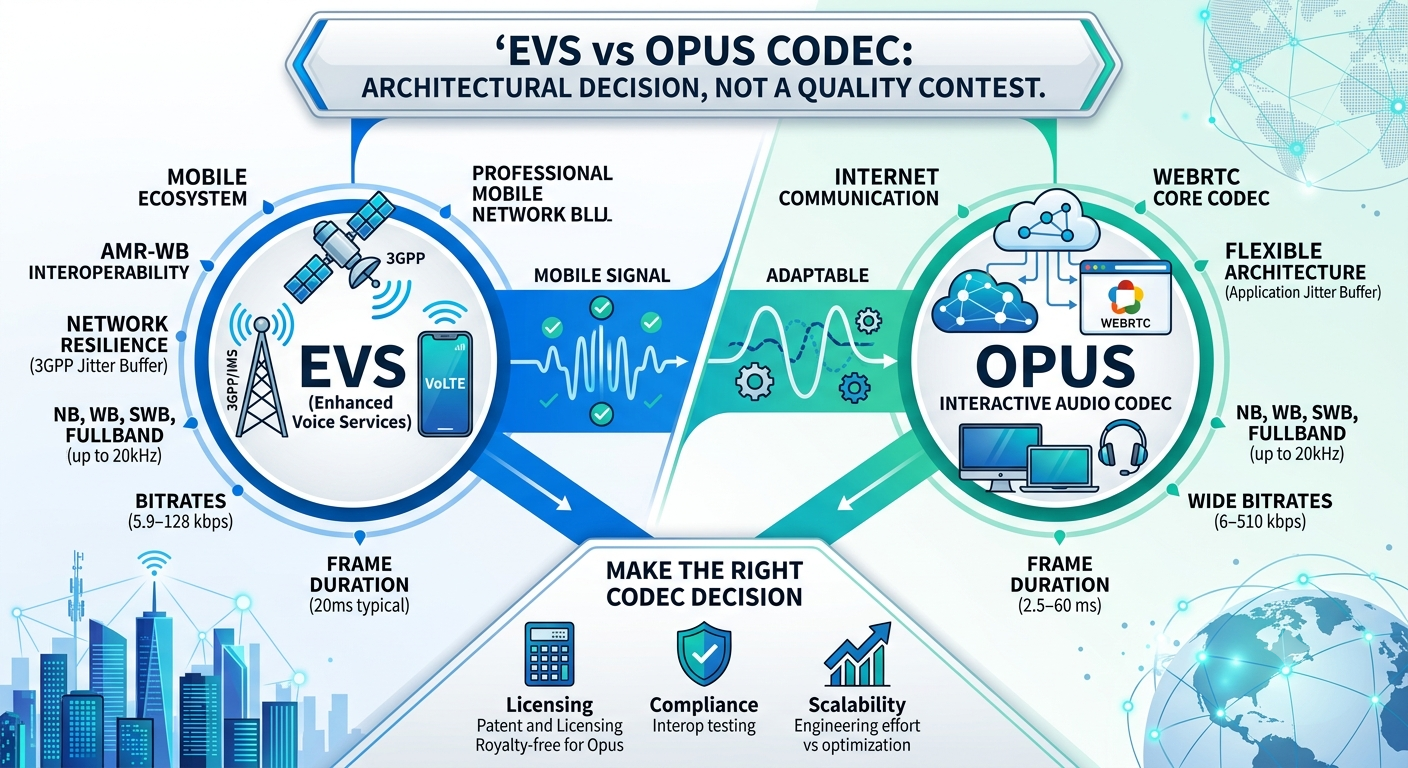
Picking an audio codec is an architectural decision, not a contest for the highest headline quality. The codec you choose shapes your bandwidth, latency, resilience on bad networks, interoperability, implementation effort, platform requirements and licensing exposure for the entire life of the product.
Two codecs come up again and again in modern real-time communications. EVS (Enhanced Voice Services) is a 3GPP-standardized codec built for mobile voice and multimedia services. Opus is an IETF-standardized interactive audio codec that powers most Internet communication and WebRTC. Both deliver high-quality real-time audio, but they were designed for different worlds.
So the useful question isn’t “which codec is better?” It’s “which codec fits the network, devices, interoperability requirements and commercial model of my application?”
EVS and Opus: Different Design Priorities
EVS was standardized by 3GPP in Release 12. Its specifications go beyond the codec itself and cover error concealment, jitter-buffer management and the other functions a mobile voice service needs. EVS also includes AMR-WB interoperability, which makes it a natural fit when your product has to live inside a 3GPP mobile voice ecosystem.
Opus was standardized by the IETF in RFC 6716 as an interactive speech and audio codec. It was built to cover a wide range of real-time uses, from narrowband speech to fullband music, and it’s a core codec for WebRTC endpoints and Internet-based communication.
EVS vs Opus: Technical Comparison
| Parameter | EVS | Opus |
| Primary ecosystem | 3GPP mobile voice and IMS-related applications | Internet communication, WebRTC and interactive audio |
| Audio bandwidth | NB, WB, SWB and Fullband; up to 20 kHz | NB, WB, SWB and Fullband; up to 20 kHz |
| Bitrate range | 5.9–128 kbps | 6–510 kbps |
| Frame duration | 20 ms | 2.5–60 ms |
| Network resilience | Specifications include packet-loss concealment and dedicated jitter-buffer management | In-band FEC (LBRR) and decoder-side loss concealment; the application controls jitter buffering |
| Interoperability focus | 3GPP/IMS/mobile voice; AMR-WB interoperability | WebRTC and Internet-based real-time communication |
| Licensing consideration | Patent/licensing requirements should be evaluated for the intended implementation and deployment | Royalty-free codec; implementation licensing still needs to be reviewed for the chosen software package |
Audio Quality and Bandwidth
On paper, the two are closer than you might expect. EVS scales from narrowband speech through wideband and super-wideband up to fullband audio. Opus covers the same range and adds a much wider bitrate span.
For an engineering team, the maximum bitrate on the spec sheet matters less than the operating point: the setting that gives you the quality you need while staying inside your bandwidth, CPU, memory and latency limits.
Latency and Frame Size
Codec frame duration is only one piece of delay. Encoder and decoder look-ahead, packetization, buffering, transport, jitter management and the rest of the audio pipeline all add up to the latency your users actually hear.
Opus offers an unusually flexible range of frame durations, from 2.5 ms to 60 ms, so you can trade packet overhead against latency and robustness. EVS commonly runs on 20 ms frames in its standard configuration, with exact behavior depending on the EVS mode and the implementation.
If low latency is critical to your product, compare complete end-to-end audio paths rather than a single codec-delay figure.
Network Resilience
Real networks drop and delay packets, so this is where the two codecs differ most in approach.
EVS has dedicated 3GPP specifications for error concealment and jitter-buffer management, which reflects its mobile-network origins. These mechanisms are meant to protect speech quality when packet timing and delivery are imperfect.
Opus handles resilience with tools such as optional in-band redundancy (FEC) and decoder-side packet-loss concealment. It doesn’t define one mandatory jitter-buffer implementation, so the surrounding media stack does a lot of the work.
Either way, judge the codec together with your RTP stack, jitter buffer, packet-loss handling and the network conditions you expect in the field.
Interoperability: Where Will the Codec Be Used?
For most projects, interoperability decides the question before quality ever does.
- Connecting to 3GPP mobile voice infrastructure? EVS support may be a hard requirement, depending on your target network and device profile. EVS also provides AMR-WB interoperability functions.
- Building a WebRTC endpoint or Internet-based communication system? Opus is central to the WebRTC model, and RFC 7874 requires WebRTC endpoints to implement it.
- Bridging both worlds? Supporting both codecs is often the most practical answer. A media gateway, conferencing platform or unified communications system may need to transcode or natively support several codec families.
Licensing and Commercial Considerations
Look at licensing early, especially if the product will ship at volume.
Opus is designed to be royalty-free, but you should still review the terms of the specific implementation you choose and any third-party components bundled with it.
EVS is standardized by 3GPP, but commercial implementations can carry patent licensing considerations. The applicable model depends on the implementation and deployment, so OEMs should confirm requirements with their codec supplier and legal advisers before productization.
Licensing is only part of the cost picture. Engineering effort, optimization, conformance testing, maintenance and interoperability testing often add up to more than the license itself.
Platform and Embedded Considerations
On application processors and servers, both codecs have mature implementations. Things get tighter on microcontrollers and other resource-limited embedded platforms.
EVS can need significant optimization on constrained processors, particularly with higher-complexity modes enabled. Opus is flexible too, but depending on configuration it can also demand substantial CPU and memory. For an embedded product, choose the codec together with the target MCU, DSP architecture, RTOS, memory budget and audio pipeline.
A useful OEM evaluation covers measured CPU load, RAM and Flash footprint, audio latency, interoperability, packet-loss behavior and how much platform-specific optimization the port will need.
When EVS Fits the Application
- Products that must interoperate with 3GPP mobile voice or IMS environments.
- VoLTE/VoNR voice engines and mobile communication products where EVS is part of the target network and device profile.
- Applications that need EVS-to-AMR-WB interoperability.
- Platforms where mobile-network-oriented resilience and the broader EVS feature set matter.
When Opus Fits the Application
- WebRTC endpoints and browser-based communication.
- Internet-based VoIP, enterprise collaboration, gaming voice and other interactive audio applications.
- Products that benefit from flexible frame durations and a broad bitrate range.
- Applications where royalty-free codec deployment is an important commercial requirement.
When Supporting Both Makes Sense
Some platforms serve more than one communication ecosystem. A system with mobile, desktop and browser clients may need EVS on one media path and Opus on another. At that point the decision becomes an implementation strategy: whether to support both natively, where transcoding is unavoidable, how media resources are allocated, and how each codec is optimized for the target platform.
How to Evaluate an EVS or Opus Implementation
- Confirm interoperability with the exact SIP, IMS or WebRTC environment you’ll deploy into.
- Measure CPU, RAM and Flash on the target hardware instead of relying on desktop benchmarks.
- Evaluate end-to-end latency, including buffering and the audio I/O path.
- Test packet-loss and jitter behavior under realistic network conditions.
- Check conformance requirements and available test vectors.
- Understand licensing obligations for the exact implementation and distribution model.
- Assess vendor support for optimization, porting and long-term maintenance.
Making the Codec Decision
EVS and Opus solve related but different problems. EVS is closely aligned with the 3GPP mobile voice ecosystem, while Opus is deeply woven into Internet-based real-time communication and WebRTC. For products that span both, supporting both can be the sensible architecture.
Base the decision on your target ecosystem, interoperability requirements, network conditions, latency budget, hardware resources, licensing model and product roadmap, and weigh them together. That will serve you better than choosing on a single quality, bitrate or delay number.
Frequently Asked Questions
1. Is EVS better than Opus?
Neither wins in every case. EVS fits products that must work inside 3GPP mobile voice and IMS networks, including VoLTE and VoNR. Opus fits WebRTC and Internet-based real-time communication. Your target network, interoperability needs, latency budget, hardware and licensing model should decide.
2. Is Opus royalty-free?
Opus is designed as a royalty-free codec and is standardized in RFC 6716. You should still review the licensing terms of the specific software implementation and any bundled third-party components.
3. Does EVS work with AMR-WB?
Yes. EVS includes an AMR-WB interoperable mode, so EVS-capable endpoints can interoperate with AMR-WB devices and networks.
4. Do WebRTC endpoints have to support Opus?
Yes. RFC 7874 requires WebRTC endpoints to implement Opus, alongside G.711.
5. Can one platform support both EVS and Opus?
Yes. Media gateways, conferencing platforms and unified communications systems that bridge mobile and Internet clients often support both, either natively or through transcoding.
How Consilient Can Help
Consilient Technologies develops optimized voice and multimedia codec software for telecom, embedded and networked applications. The portfolio includes EVS, AMR and VoLTE/VoNR voice-engine technologies, along with voice-quality enhancement and embedded communication software. If your product needs codec integration, optimization or porting, Consilient can support evaluation and platform-specific implementation.
Need EVS on your target platform, or not sure which codec fits your product? Talk to Consilient’s codec team about your requirements.